
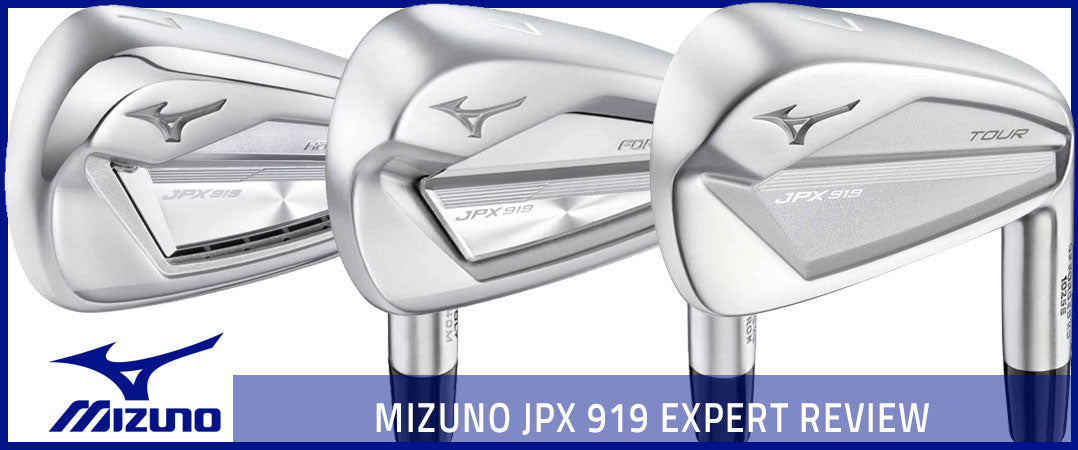
Nothing compares to the feel of Mizuno irons, or so says every golfer who's ever hit a set. I've played Mizuno MP-68 irons for 8 years, so count me among them, which is exactly why I jumped at the chance to take a full set of Mizuno JPX 919 irons out for extended on-course testing.
Before getting into how they played, it's worth covering the history and technology behind the JPX 919 line.
A Bit of Background
In 2002, Mizuno introduced the newly branded MP line of players irons, and it's stood as the gold standard in that category ever since. The current iteration is the MP-18 lineup, which includes the MP-18, MP-18 SC, and MP-18 MMC iron sets.
Mizuno also introduced a more technology-driven MX line back in 2002, which was later replaced by the JPX line in 2011. The current JPX 919 lineup features three models: Tour, Forged, and Hot Metal.
All three are built around Mizuno's Stability Frame, a cavity-back design that opens up the heel to optimize weight in the toe and perimeter, giving the JPX 919 more forgiveness than the MP-18 line. Where the MP line is a traditional players iron, JPX has always been the technology-driven option, with a model built for players of pretty much every ability.
Mizuno JPX 919 Tour Irons

Mizuno JPX 919 Forged Irons

Mizuno JPX 919 Hot Metal Irons

The Tour heads are Grain Flow Forged HD from a single billet of 1025 Pure Select mild carbon steel, and the Forged heads use the same process from a 1025 Boron billet. The Hot Metal irons are made from Chromoly 4140M, chosen for its high strength-to-weight ratio and malleability, which allows for a thin, high-strength face along with a bendable hosel for fitting.

All manufacturers forge irons, so what makes Mizuno's process different? Their engineers found a way to make the bottom of the clubhead denser than the top line, essentially compacting the metal more tightly near the sole than near the top. That extra density lower in the head is what gives Mizuno irons their distinct feel.
On-Course Testing
I spent my on-course time with the Tour and Forged heads, since those fit my game best. The Hot Metal shafts were too light for my swing, so I tested that set at the range instead to get a feel for how it looked and played.
For the first round, I carried both the Tour and Forged heads, playing the front nine with the Tour version and the back nine with the Forged.
Mizuno JPX 919 Tour Irons


Right off the bat, I liked the way the Tour irons felt in hand, balanced with a true, thin top line. There's a bit more weight sitting lower in the clubface at address, which gives these irons a solid feel before you even swing.
Compared to the JPX 900, I prefer the styling of the 919. The low-glare Pearl Satin finish looks great, the lines are clean, and the open heel construction gives it a confidence-building look.


It took a few holes to find my groove with the Tour irons, but once I did, I loved them. The turf interaction is excellent, Mizuno beveled the edges well enough to make that noticeable on nearly every swing.
What stood out most was how straight the ball flight was for a players iron, very little left-right movement. Even off-center hits still jumped off the face with clean contact and carried close to the same distance as a pure strike.
On the back nine with the Forged heads, I felt comfortable right away. The shafts I had were a touch too light for me, so a few shots ballooned, but the turf interaction was just as good and the ball came off hot and straight.
Mizuno JPX 919 Forged Irons


The Forged head's footprint isn't much larger than the Tour, and most of the added bulk in the Stability Frame stays hidden behind a thin top line at address. Coming from 8 years playing a blade, I didn't mind the extra forgiveness from the deeper cavity and thinned face. They weren't quite as crisp-feeling as the Tour heads, but they still rank among the best-feeling cavity backs I've hit.
The next day I went back to the Tour heads for a full round, rather than switching sets at the turn, which let me focus on playing instead of testing.
Right from the start I was on fire, four birdies in a row through the middle of the front nine, taking dead aim at every pin. I missed an ace by less than a foot on a 195-yard par 3, completely locked in.
After just 9 holes with the Tour heads the round before, I was surprised how much confidence I'd already built with them. By the middle of the round I could walk up, pick a target, and swing, knowing exactly where the shot was going.
Ball flight stayed right on line, and when I did need to work it left or right, it responded, just with more control than I get from my MP blades. The Stability Frame gives these irons a stable feel that seems to reward a repeatable swing.
I finished that round with one of my best scores of the season, and I credit the JPX 919 Tour irons with minimizing the damage from my usual miss, a snap hook.
Mizuno JPX 919 Hot Metal Irons
After the second round, I went to the range to spend more time with the Forged irons and get a real feel for the Hot Metal set. Both carry stronger lofts than the traditionally-lofted Tour heads, so it wasn't surprising to see the ball jump off the Forged face at the range. The 1025 Boron construction let Mizuno CNC mill the back of the face thinner higher up, adding more spring.
The Hot Metal irons deliver exactly what's advertised, the ball jumps off the face. What impressed me most was how much design detail carried through the whole lineup. Despite packing in serious game-improvement technology, Mizuno kept the look consistent from the Tour version all the way through Hot Metal.


The beveled leading and trailing edges on this true game-improvement iron stood out too, a feature that should help players with inconsistent strikes get better turf interaction and, in turn, better ball striking.
Head-to-head: I finished testing at Pro Golf Discount in Bellevue, WA, putting the JPX 919 Tour head against the MP-18 SC. Mizuno used 6-irons as their MP-18 demo club but moved to the industry-standard 7-iron for JPX 919, so it wasn't a perfect apples-to-apples test, but the data was still useful: the JPX 919 came in just a touch shorter than the MP-18 (expected, given the cavity back), but nearly halved the left-right dispersion, a significant find. That's a tradeoff of 2 to 3 yards I'd take every time for tighter dispersion.

Final Take
The JPX 919 line comes from Mizuno's game-improvement side, but my testing turned up a fit for nearly every player, from beginners to a PGA Tour major champion. These irons simply outperform. The satin finish looks incredible, the redesigned back is modern, and at address, the JPX 919 makes me want to pull the trigger and hit it close every time.
Mizuno's craftsmanship sits at the top of the industry, clean, classic, built from the finest metals available. Yet at my local courses, I still see far more TaylorMade, Titleist, and Callaway irons in bags than Mizuno. Whether that comes down to bigger marketing budgets or golfers wanting to play what their favorite tour pro plays is hard to say.
Either way, take this reviewer's advice: next time you're at a demo day or a shop that has Mizuno irons out, add them to your list. See what all the feel talk is about, you won't be disappointed.
Played a set of JPX 919s yourself? Feel free to share your take in the comments below.